Wednesday, 23 March 2011

Storyboard


Shot 1
Shot: Mid/ long shot of character
Action: Setting up the webcam, adjusting it
Duration: 3-5 seconds
Sound: Diegetic sound of the movement of the camera, slight rustling as its moved into position
Lighting: Artificial key lighting, lamp placed near character to highlight the area in which he is sitting whilst the rest of the room falls into shadow

Shot 2
Shot: Mid/ Close-up of character
Action: Character is facing the webcam directly, sitting slightly back on a desk chair. Hands are folded in lap, looks slightly uncomfortable.
Duration: 10/15 seconds
Sound: Diegetic ringing/buzzing of webcam due to recording, slightly muffled sound due to the boys average equipment.
Lighting: Same as before, illuminating character.
Dialogue: "I've been planning to do this for a while now (long pause)..."


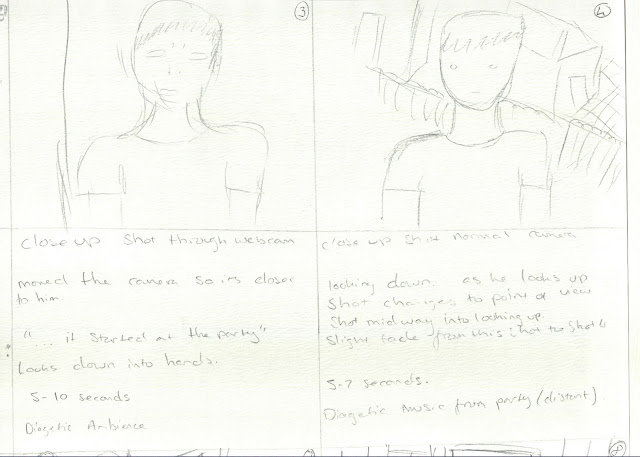
Shot 3
Shot: Close-up, point of view through webcam
Action: Character shifts uncomfortably, as though under interigation. Looking down at lap, twiddling fingers
Duration: 5-10 seconds
Sound: Same ambience as before
Lighting: Same as previous
Dialogue: "(continuing from previous)..ever since the family party..."

Shot 4
Shot: Close-up, point of view through webcam
Action: Character looks down awkwardly at lap, as he looks up


TO BE FINNISHED

Film Rating

All film ratings are audited by the BBFC, British Board of Film Classification which allows the content to be rated and assigned an appropriate minimum age range that are allowed to view it. Film ratings are very important because they allow film makers to create films that are extreme without causing distress to inappropriate audiences, because they can be shown to mature audiences who are capable of understanding the logic and meaning behind some complex issues. It also allows film makers to pinpoint their target audience, because if the film includes issues relatable to an average teenager, they can request a rating that reflects this.


I came across an interesting video when deciding the film rating of our short film, in which Shane Meadows makes a point that 'This Is England' was rated an 18 because of the fight scene at the end, which meant that some of the actors who stared in the film, including main character Thomas Turgoose who played Shaun, where unable to view it in cinema or premier at its release. His irritation came from the fact that films depicting war, mass battle and violence were not rated as certificate 18 yet through having the fight scene at the end his was. Watching this gave me some serious consideration, as by rating our film too low inappropriate audiences who couldn't appreciate or understand it could view it, and by rating it too high we could exclude some of our target audience and appear patronising not allowing younger people to watch it.


I think our film is most suited to a certificate rating of 15. The content of the film is not visual nor distressing enough to be classed as an 18 in my opinion, as the film focuses on somebody more around the age of 15-16 and is very much psychological. After watching the interview above I have also chosen for our film to be a 15 because I want people around that age who can relate to be able to watch it, as rating of 18 excludes a large section of a possible audience of teenagers.
However the reason we haven't rated as a 12 is because some of the themes and issues implied and shown are too mature for someone of that age, and won't be fully understood therefore defeating the purpose of the film.


Below is the bbfcs criteria for a film to rated a fifteen certificate, and I have written in red in each section to explain how this relates to our film, justifying our decision.
Suitable only for 15 years and over, no one younger than 15 may see a ‘15’ film in a cinema. No one younger than 15 may rent or buy a ‘15’ rated video work.
Discrimination
The work as a whole must not endorse discriminatory language or behaviour. Our film contains no discriminatory language or behaviour, with only one reference to homosexuality used in a mild, non offensive format.
Drugs
Drug taking may be shown but the film as a whole must not promote or encourage drug misuse. The misuse of easily accessible and highly dangerous substances (for example, aerosols or solvents) is unlikely to be acceptable. Our film does not show, promote or encourage any form of drug taking or solvent abuse. The implication of drinking alcohol is shown once, but not in an extreme manner.
Horror
Strong threat and menace are permitted unless sadistic or sexualised. Our film contains elements of slight sexual and abusive threat, but in a subtle and non-visual form.
Imitable behaviour
Dangerous behaviour (for example, hanging, suicide and self-harming) should not dwell on detail which could be copied. Easily accessible weapons should not be glamorised. There is reference to dangerous behaviour at the very ending of our short film, however the deed itself is not shown, glamorised or encourage as the character performs their actions within context and due to their personal situation. No detail of the actual suicide is dwelled on.
Language
There may be frequent use of strong language (for example, ‘fuck’). The strongest terms (for example, ‘cunt’) may be acceptable if justified by the context. Aggressive or repeated use of the strongest language is unlikely to be acceptable. No or very minimal swearing is used throughout the film, with only one reference to an offensive term that is not considered as swearing.
Nudity
Nudity may be allowed in a sexual context but without strong detail. There are no constraints on nudity in a non-sexual or educational context. The implications of nudity are shown once, with no detail and within context of the narrative.
Sex
Sexual activity may be portrayed without strong detail. There may be strong verbal references to sexual behaviour, but the strongest references are unlikely to be acceptable unless justified by context. Works whose primary purpose is sexual arousal or stimulation are unlikely to be acceptable. Our film contains one verbal reference, which is more of an implication to sexual abuse, and one scene that is not visual and very much implies the act of sex. The films purpose is not sexual arousal or stimulation.
Theme
No theme is prohibited, provided the treatment is appropriate for 15 year olds. The themes covered in our film are mature, however realistically a fifteen year old would be aware of all of them and is mature enough for exposure because its done in a subtle way that implies rather than portrays.
Violence
Violence may be strong but should not dwell on the infliction of pain or injury. The strongest gory images are unlikely to be acceptable. Strong sadistic or sexualised violence is also unlikely to be acceptable. There may be detailed verbal references to sexual violence but any portrayal of sexual violence must be discreet and have a strong contextual justification. Any form of violence, sexual or non is discreet in our film and does not dwell on the deed itself and the pain inflicted upon the person.




Audience Research Quantitive

For our quantitive audience research, we will be compiling a questionnaire to be handed amoungst a large amount of people of all ages, ideally we will want our questionnaire to be completed by 100 + people.
A sample of our questions;

1. Do you enjoy Drama films?

2. What are your favourite drama films?

3. How often do you watch Drama films?

4. What key features do you think makes a good drama film?

5. Do you enjoy Thriller films?

6. What are your favourite Thriller films?

7. How often do you watch Thriller films?

8. What key features do you think makes a good Thriller film?

In a later post I will include the results of the questionnaire, and analysis of the answers.

Audience Research Qualitive

Focus groups are used primarily to discover opinions, beliefs, attitudes, perceptions and to get general feedback on your product, to ensure it is meeting its specifications within your target audience. A discussion is held between the group members behind the product, and the selected group you are asking.

There are eight different types of focus group we could decide to use, I have written my personal opinions on each one:
Online focus group - computers connected via the internet are used. I feel this could be effective for us to gain insight of peoples opinions that we cannot discuss in person, for example people from other parts of the country or different countries entirely. Getting opinions from people from a variety of places is something I think would be very interesting and help us broaden our horizons.
Teleconference - Telephone networks are used. Again this would help us to communicate with a variety of people, yet I do not think it would be as effective as using the internet, through typing we would be able to plan our questions and responses more carefully and effectively, as in spur of the moment it can be difficult to ensure you are saying exactly what you want to.
Mini focus groups - Groups composed of four or five members. By having a smaller number of members we can ensure we are more attentive to each person within the focus group, and have more time to discuss with each member, therefore I think this would be beneficial for us.
Two way focus group - One focus group watches another and discusses the observed interactions and conclusion. This could be interesting as a way of gaining more insight, yet I don't feel its entirely what is most appropriate for our group, as we are just seeking feedback and opinions from our target audience.
Dual moderator focus group - One moderator ensures the session progresses smoothly, while another ensures that all the topics are covered. This could be useful to ensure we cover everything we set out to do, but I don't think it will be essential for us.
Dueling moderator focus group - Two moderators deliberately take opposite sides on the issue under discussion. This isn't appropriate for us as we are not arguing for or against an issue but trying to receive feedback on a product.
Respondent moderator focus group - One of the respondents is asked to act temporarily as a moderator. We will want all of our respondents to take part in the discussion, so we will not use this method.
Client participant focus groups - One or more client representatives participate in the discussion. This will not be appropriate for us either, as we want to discuss with a group of people to get a variety of opinions.

We will be using the mini focus group, allowing us to attentively discuss with four - five members, meaning we can receive a variety of opinions and feedback.
We will us our friends as our focus group, as they are the right age for the target audience and much like the target audience member I previously described, with varying film tastes. In a later post I will include the questions asked, notes I have made from them and analysis of the answers given.

Target audience

When deciding our target audience, we needed to ensure we chose an age group that would understand the concepts shown within our film, and possibly be able to relate to them which is why we decided our main target audience is people around our age group, that are mature enough to deal with the issues raised. Between the age of 15-25. Below I have visualised our stereotypical target audience member.


Age: 17 - 25
Our target audience member would be someone passionate about the arts, who can appreciate filmaking particularly independent film. Somebody who is sociable, and enjoys pass times such as visiting local cinemas. The person would have a level of maturity that allows them to understand real life, complex issues and be able to deal with them a person who is able to face reality. Other possible subjects the person might enjoy would most probably be creativity based, art, English etc.
The target audience member would need to be open-minded, perceptive and be able to generate opinions.

Inspiring film 'Cape Fear'

Cape fear is another film that greatly inspired us, the following extract is the films opening. I particularly like the first few minutes in which the girl is addressing the audience.


Inspiring film 'About a girl'

We were greatly influenced when watching the short film 'About a girl'
'As a girl goes walking alongside a canal, her stories become more and more underlain by an uncomfortable feeling that the gravity of her experience does not match her flippant retelling of her everyday life; her descriptions of pop idols and her favourite ice-cream are mixed with hints about family troubles, poverty and domestic violence.'